Statement Analysis Review Workbench
- Financial statements
- TypeScript
- Synthetic data
- Evaluation
Status: Static browser prototype
Evidence highlights
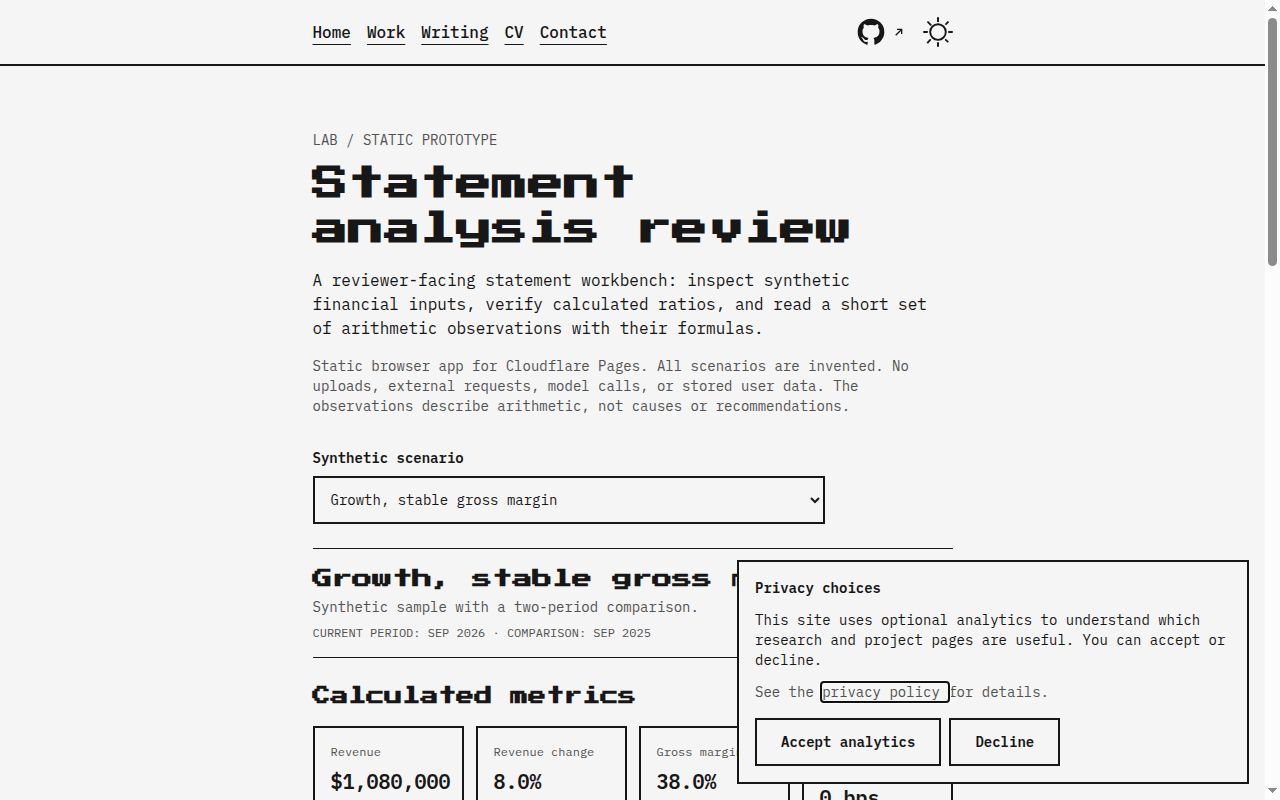
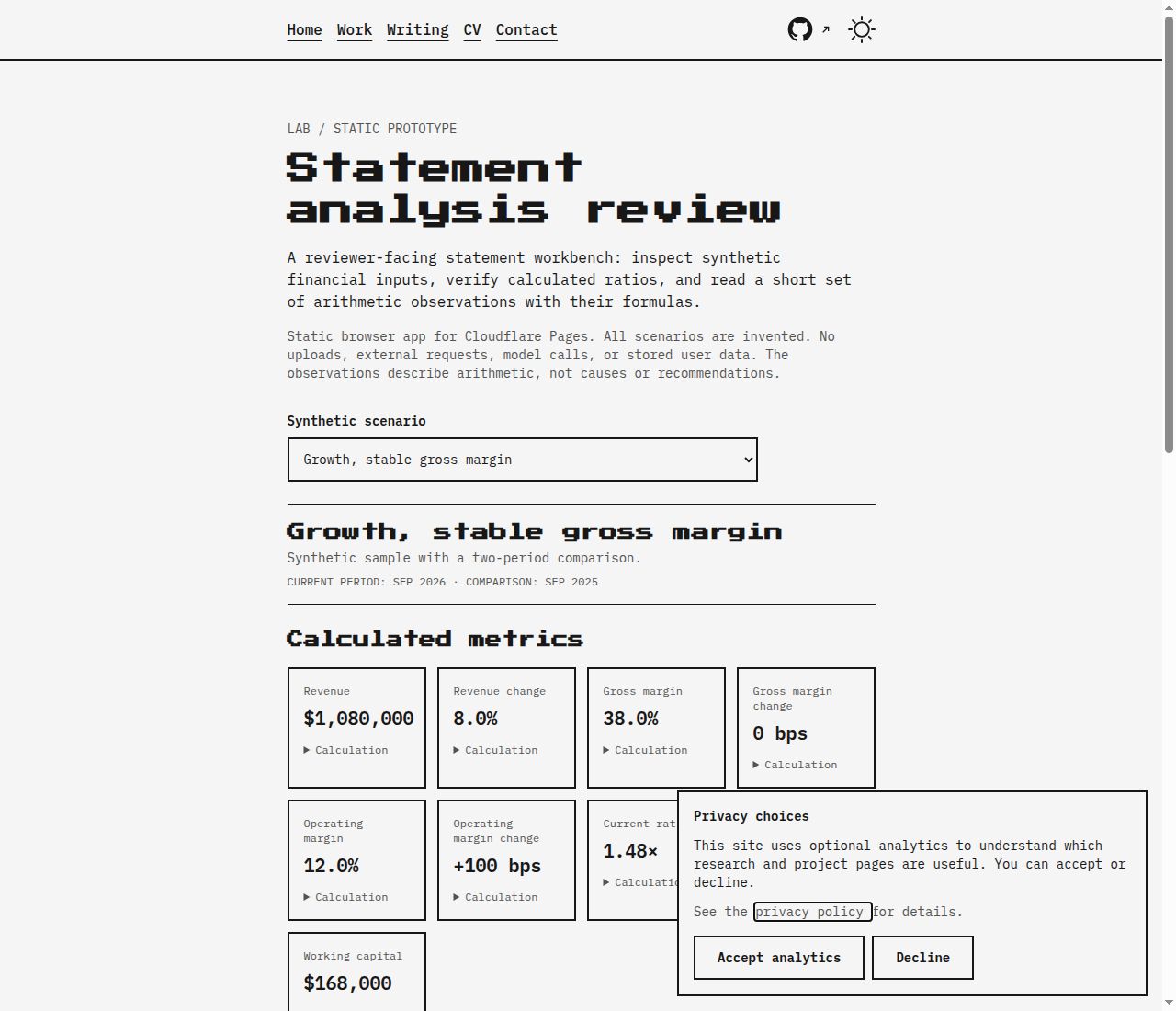
- Calculates revenue change, margins, liquidity, and working capital from visible synthetic inputs.
- Leaves comparisons unavailable when the prior period or a valid denominator is missing.
Project evidence links
Project screenshots
What a 30-minute review should inspect
Open the interactive workbench and check:
- Scenario coverage — margin pressure and missing-comparison cases, not only the happy path.
- Formula traces — each ratio shows the source values used.
- Missing data — comparisons stay unavailable when the prior period or a valid denominator is missing.
- Observation discipline — arithmetic descriptions only; no inferred causes or recommended actions.
Then inspect the source and tests.
Purpose
This work sample explores a finance reviewer’s path from structured statement inputs to a small set of checkable observations. It complements the variance workbench by focusing on statement-level comparisons rather than queue management.
Status and evidence boundary
Status: static browser prototype on Cloudflare Pages–compatible assets. All records are synthetic. The workbench does not parse uploaded statements, call an LLM, access customer systems, save reviewer data, or establish accounting policy.
Static hosting is deliberate for this public sample: it avoids handling sensitive uploads, credentials, or financial data. A real enterprise deployment would need permission-aware integration, data retention controls, finance-approved definitions, audit persistence, security review, and domain-reviewed evaluation before model-assisted narratives were introduced.